
Review of the case law of the European Court of Justice: March 2026

Jurisprudência

March 2026 saw a number of relevant judgments from the Court of Justice of the European Union (CJEU) addressing important issues in consumer law. These decisions contribute to clarifying the interpretation of EU directives and regulations and further develop core principles such as consumer protection, legal certainty, and market fairness. Below is an overview of rulings delivered in this month, highlighting their practical implications for businesses, consumers, and regulators across the EU.

Consumer Assistance Does Not Preclude Distance Contract Status, but Withdrawal May Be Abusive

In its judgment of 5 March 2026 (Case C-564/24), the Court of Justice interpreted key provisions of Directive 2011/83/EU concerning the notion of a distance contract and the right of withdrawal. The case concerned a dispute between Eisenberger Gerüstbau GmbH and a consumer (JK), who, after concluding a contract for scaffolding works through an architect acting on her behalf, sought to withdraw from that contract and recover payments already made. The referring German court asked whether the involvement of a trader assisting the consumer affected the classification of the contract and the applicability of consumer protection rules. The Court held that the fact that a consumer is assisted by another trader — even where that trader initiates contact with the service provider and influences key contractual terms — is not relevant for determining whether the contract qualifies as a “distance contract” within the meaning of Article 2(7). Nor does such assistance affect the consumer’s status, which must be assessed objectively by reference to the purpose of the contract. The Court further clarified that an addendum concluded exclusively through means of distance communication may itself constitute a distance contract, even if the main contract does not, provided the conditions laid down in the directive are met. Finally, the Court ruled that, although consumers benefit from a broad right of withdrawal, its exercise may, in exceptional circumstances, be considered abusive. This may be the case where the consumer withdraws at the end of an extended withdrawal period after the services have already been fully performed, with the intention of avoiding payment. However, such abuse must be established by the national court on the basis of all the circumstances, including both objective and subjective elements. This decision is discussed here.

Reduced VAT for Accommodation May Exclude Ancillary Services Without Breaching EU Law

In its judgment of 5 March 2026 (Joined Cases C-409/24 to C-411/24), the Court of Justice interpreted Article 98 of Directive 2006/112/EC concerning reduced VAT rates and their application to accommodation services supplied to consumers. The cases concerned disputes between German hotel operators and tax authorities, where services such as breakfast, parking, Wi-Fi, and wellness access were provided together with short-term accommodation and paid for by consumers under a single price. The referring court asked whether EU law precludes national rules requiring those services to be separated and taxed at the standard rate, even where they are ancillary to the principal accommodation supply. The Court held that EU law does not preclude such national legislation. It confirmed that, although ancillary services may form part of a single economic supply from the perspective of consumers, Member States may apply reduced VAT rates selectively to specific aspects of the categories listed in Annex III. Accordingly, accommodation services supplied to consumers may be distinguished from other services provided alongside them, provided that this distinction is based on objective criteria. The Court also clarified that the classification of a transaction as a single supply is not decisive where such discretion is exercised. Finally, the Court emphasized that the principle of fiscal neutrality must be respected. This requires that similar services from the perspective of consumers — such as breakfast or parking offered independently — are not treated differently for VAT purposes. Therefore, excluding ancillary services from the reduced rate is permissible, provided that they are subject to the same standard rate whether supplied independently or together with accommodation. The final assessment remains for the national court.

Virtual Game Currency Is Not VAT-Exempt and Must Be Fully Taxed, with No Special Treatment for Consumers

In its judgment of 5 March 2026 (Case C-472/24), the Court of Justice interpreted provisions of Directive 2006/112/EC concerning VAT exemptions for currency transactions and the concept of vouchers. The case concerned a dispute between MB “Žaidimų valiuta” and the Lithuanian tax authority regarding the VAT treatment of transactions involving the purchase and resale of virtual currency (“Gold”) used in the online game Runescape, including implications for consumers engaging in such exchanges. The referring body asked whether those transactions could be exempt as currency operations or treated as multi-purpose vouchers, and how the taxable amount should be calculated. The Court held that virtual game currency such as “Gold” does not fall within the VAT exemption for currency transactions under Article 135(1)(e), since it is not accepted as an alternative means of payment outside the game and does not function as a genuine currency for consumers in the wider economy. It further clarified that such virtual units cannot be classified as vouchers within the meaning of Article 30a, because they do not entitle consumers to receive distinct goods or services but instead constitute the very digital service consumed within the game. Consequently, the transactions must be treated as taxable supplies of electronic services. Finally, the Court ruled that VAT must be calculated on the full amount received for the sale of the virtual currency, rather than only on the trader’s margin, meaning that no preferential calculation method applies even where consumers are involved in the transaction chain.

Limitation Periods and Consumer Awareness: CJEU Strengthens Protection Against Unfair Terms in Foreign Currency Loans

In its judgment of 19 March 2026 (Case C-679/24), the Court of Justice of the European Union interpreted Articles 1 and 7 of Directive 93/13/EEC concerning the effectiveness of consumer protection in relation to limitation periods for claims based on unfair terms. The case arose from a dispute in Hungary between a consumer and financial institutions regarding a foreign-currency loan agreement containing a clause placing exchange rate risk entirely on the consumer. The referring court asked whether EU law precludes national rules under which a consumer’s claim for the legal consequences of the invalidity of such an agreement is subject to a five-year limitation period running from the date of conclusion of the contract, and whether judicial decisions could affect the starting point or suspension of that period. The Court held that EU law precludes a judicial interpretation of national law under which such a limitation period begins to run from the date the contract was concluded, where the consumer was not aware and could not reasonably have been aware of the unfairness of the term at that time. It emphasized that such a rule risks making the exercise of consumer rights excessively difficult, contrary to the principle of effectiveness. The Court further clarified that the date of judgments of the Court of Justice or national supreme courts cannot be used to determine the starting point or resumption of the limitation period, since consumers cannot be expected to monitor or interpret case-law developments in order to assert their rights. Only a final judicial decision concerning the specific consumer, duly notified, may establish awareness sufficient to trigger the limitation period. The final assessment of whether the consumer could reasonably have been aware of the unfairness remains for the national court.

“Final Price”… but with Conditions: CJEU Clarifies When Extra Fees Stay Outside the Listed Price

In its judgment of 26 March 2026 (Case C-62/25), the Court of Justice of the European Union interpreted Article 2(a) of Directive 98/6/EC concerning the concept of ‘selling price’ in the context of online sales. The case arose from a dispute in Germany between a consumer protection association and an online retailer regarding whether flat-rate processing fees, charged only when the total order value falls below a certain threshold, must be included in the advertised price of a product. The Court held that such fees do not have to be included in the ‘selling price’. It clarified that the selling price must comprise all unavoidable and foreseeable components of the price that constitute the consideration for acquiring the product. However, flat-rate processing costs of this kind are not necessarily payable, since consumers may avoid them by increasing the total value of their order beyond the minimum threshold. As a result, they do not form part of the final price of a unit of the product within the meaning of the directive. The Court further emphasized that including such variable and conditional costs in the selling price could undermine price transparency and hinder consumers’ ability to compare offers effectively. By contrast, indicating those costs separately—provided they are clearly disclosed—better serves the objectives of Directive 98/6, namely ensuring precise, transparent, and unambiguous price information. The Court also noted that an average consumer is capable of combining the product price with any additional fees to determine the total amount payable. Accordingly, the Court concluded that EU law does not require flat-rate processing fees, which depend on the total order value and apply only below a minimum threshold, to be included in the selling price, as long as those fees are clearly indicated and do not become unavoidable in practice.

Heritage or Hype? CJEU Clarifies When Luxury Branding Becomes Misleading

In its judgment of 26 March 2026 (Case C-412/24), the Court of Justice of the European Union interpreted Article 3(1)(g) of Directive 2008/95/EC concerning deceptive trade marks. The case arose from a dispute between luxury leather goods companies regarding the validity of trade marks incorporating the number “1717”, which was perceived by consumers as indicating the historical origin of the brand and suggesting long-standing know-how. The referring court asked whether a trade mark may be considered deceptive where it conveys false information about the age and heritage of the undertaking, leading consumers to infer that the goods possess qualities such as prestige or superior craftsmanship. In particular, the question was whether such misleading indications, although relating formally to the undertaking rather than directly to the product, could nonetheless fall within the prohibition of deceptive marks. The Court held that a trade mark may be refused or declared invalid where it creates actual deception or a sufficiently serious risk of deception regarding the characteristics of the goods. It clarified that, while misleading information about the undertaking itself is not sufficient as such, it may fall within Article 3(1)(g) where it leads consumers to infer incorrect characteristics of the goods, such as quality or prestige. In the luxury sector, those intangible elements—linked to heritage, craftsmanship, and brand image—may constitute essential product characteristics. Accordingly, the Court found that the inclusion in a trade mark of a date perceived as indicating the historical establishment of a business may be deceptive where it falsely suggests long-standing know-how that enhances the perceived quality and prestige of the goods. This is particularly relevant where consumers attach significant importance to heritage in their purchasing decisions. The final assessment remains for the national court, which must determine how the mark is perceived by the relevant public and whether it conveys such misleading associations.

Defective Products Liability in the EU: CJEU Confirms Fault Claims, Clarifies Limitation Periods, and Upholds 10-Year Longstop

In its judgment of 26 March 2026 (Case C-338/24), the Court of Justice of the European Union interpreted Directive 85/374/EEC on liability for defective products, in a case concerning a claim for damages following vaccination and the impact of a progressive illness on limitation periods. The referring court asked, in particular, whether EU law allows parallel reliance on fault-based liability, how to determine the starting point of the three-year limitation period, and whether the directive’s 10-year longstop is compatible with the right to effective judicial protection under Article 47 of the Charter. The Court held, first, that Article 13 of the directive does not preclude injured persons from bringing claims under national fault-based liability systems, provided that those claims are based on a different legal basis than the strict liability regime established by the directive. It confirmed that conduct such as maintaining a product on the market despite knowledge of its risks, or failing to comply with duties of vigilance, may constitute independent fault capable of giving rise to liability. As regards limitation periods, the Court clarified that the three-year period under Article 10(1) begins when the claimant becomes aware, or should reasonably have become aware, of the damage, the defect, and the identity of the producer. It rejected the interpretation that this period only starts upon stabilization of the damage, holding instead that it is sufficient that the damage has become apparent and can be linked to the product, irrespective of its subsequent evolution. Finally, the Court upheld the validity of the 10-year longstop period laid down in Article 11, finding that it does not infringe the right of access to a court. It emphasized that the provision pursues legitimate objectives of legal certainty and balanced allocation of risk, and that injured persons retain a real opportunity to bring proceedings within the prescribed time limits, including in cases involving progressive harm.

Preços misteriosos e água gratuita: reflexões de uma viagem aos EUA

Doutrina

Viajar é conhecer outras culturas, outras realidades, outros hábitos, outras práticas. É perceber que, também no que respeita ao consumo, há diferenças legais e culturais relevantes.

Numa recente viagem aos EUA de férias, percebi que há algumas diferenças relevantes que me parece interessante partilhar. Num caso, as diferenças não colocam a realidade portuguesa num bom cenário, noutros o consumidor português encontra-se mais bem protegido. É importante notar que, nos EUA, existem diferenças muito significativas de Estado para Estado.

Começo pelos preços e pela sua indicação.

Na maioria das lojas de uma região da Flórida que visitei, o preço não se encontra afixado ou não é visível. Isto significa que o cliente não sabe, à partida, quanto é que tem de pagar para comprar a coisa.

Isso implica perguntar. E estar, por isso, em contacto com o representante da empresa, que assim já se apercebeu do interesse da pessoa e pode, com as técnicas que tiver, interagir, pressionar, convencer. Muitas vezes, não é apenas indicar o preço. É mostrar melhor essa e outras coisas, relevando as características que entender, que lhe parecerem melhores para que o consumidor decida comprar.

Além da omissão da indicação do preço, este, quando indicado ou transmitido, não é o preço final. Ainda é necessário acrescentar o imposto ou impostos sobre o consumo que forem aplicáveis. Assim, se um café custa dois dólares – e o café nunca custa apenas dois dólares –, o preço a pagar será sempre superior, e desconhecido sem contas incertas.

Os impostos dependem do estado, do município, da localidade, pelo que é sempre surpreendente o que nos é dito para pagar. Bem podemos querer gastar as últimas moedas que temos na carteira, bem contadas e ajustadas ao que escolhemos. No final, são mais uns cêntimos. E acabamos por sair com mais moedas do que aquelas com que entrámos.

Em restaurantes, há ainda a surpresa do serviço acrescentado ao valor da refeição. Nunca é certo o que será cobrado. Cinco por cento. Dezoito por cento. Vinte por cento. E ainda é muito apreciada uma gorjeta adicional.

Em Portugal, o cliente sabe sempre o que tem de pagar, incluindo o preço da coisa, os impostos e quaisquer outros valores incluídos no preço. O valor indicado tem de ser o valor total.

As empresas têm, assim, um custo acrescido associado à indicação do preço em cada contexto, em função das taxas aplicáveis. Num contexto, como o dos EUA, em que o imposto sobre o consumo pode variar de cidade para cidade, poderia ser realmente muito exigente obrigar a indicar o preço final em cada caso. Ainda assim, tal permitiria ao cliente tomar uma decisão mais esclarecida.

Imagem gerada por IA

Em sentido inverso, a água é realmente gratuita para o cliente. Pede-se água em qualquer restaurante, e vem água da torneira, fresquinha, reposta regularmente, sem qualquer custo. A não ser o custo da refeição, claro.

Bem sabemos, como aqui já se deixou escrito, que, em Portugal, o cliente também tem direito a copos de água gratuitos. No entanto, generalizou-se nos últimos tempos a prática de encher umas garrafinhas bonitas com água da torneira e cobrar por esse “serviço”. Em alguns casos, a água é apresentada como tratada, depurada, quem sabe benzida pelo Deus dos líquidos puros. Ainda que assim seja, esta parece ser apenas uma prática destinada a contornar a obrigação de fornecer copos de água gratuitos.

É certo que é uma prática relativamente sustentável, em comparação com a tradição portuguesa, uma vez que se evita a utilização de muitas garrafas de plástico. Cumpre-se um dos objetivos. Mas à custa dos direitos dos clientes.

Nos EUA, tal como aliás em muitos outros países, mesmo europeus, a prática é limpa, linear, comum. O cliente não se sente mal por pedir e beber água.

Mesmo de férias, o consumo não nos larga. E é uma boa oportunidade para pensarmos em diferentes realidades e nos aspetos positivos e negativas de outras práticas.

Gorjeta incluída na conta

Doutrina

Nos últimos anos, tem-se generalizado em alguns restaurantes, em especial os de gama mais alta, uma prática que consiste em incluir na conta um valor relativo a gorjeta, sendo em regra apresentados dois preços, um sem gorjeta e o outro com esta incluída. A percentagem é variável, situando-se em torno de 5% a 10%.

Esta prática parece-me contrária ao Direito português vigente, pelo menos nos casos em que se trate de uma relação de consumo, ou seja, o cliente não esteja a agir na qualidade de profissional na relação com o restaurante.

A análise que se segue tem como base os princípios do Direito do Consumo e a sua aplicação a esta situação concreta.

As principais questões colocam-se ao nível da transparência e da lealdade. No entanto, antes de entrar na sua análise, importa perceber as razões que estão subjacentes a esta prática.

Trata-se de uma forma de aumentar o valor pago pelo cliente, que tem como destinatários os trabalhadores dos restaurantes. Ou seja, está em causa uma prática que visa aumentar a parte variável da remuneração dos trabalhadores, relativa às gratificações dadas pelos clientes. A sua inclusão na conta poderá ter a vantagem de ser mais claro, do ponto de vista da tributação, qual o rendimento relevante. Haverá, portanto, um interesse geral subjacente a esta prática, ainda que indiretamente considerado.

Do ponto de vista do Direito do Consumo, a prática é, no entanto, muito problemática.

Desde logo, levanta problemas de transparência.

Com efeito, o consumidor não tem conhecimento, quando lhe é apresentado o menu, que, ao valor da comida e das bebidas, será aplicada, no final, uma percentagem variável, não obrigatório, na conta. Tipicamente, não é afixado qualquer cartaz com essa informação no restaurante, não constando igualmente da ementa a referência a essa percentagem nem a circunstância de esta ser posteriormente apresentada com a conta. Assim, quando está a fazer as contas quanto ao que irá gastar, o consumidor não inclui esse montante na operação.

O preço é um elemento essencial da decisão de contratar do consumidor e deve ser obrigatoriamente incluído antes de este avançar para a decisão de transação. Tal é exigido pelo art. 1.º do DL 138/90 (regime da indicação de preços), aplicável aos serviços por via do art. 10.º do mesmo diploma. Também o art. 8.º-1-c) da Lei de Defesa do Consumidor e o art. 10.º-c) do DL 57/2008 (práticas comerciais desleais) impõem a indicação do preço, incluindo taxas e impostos, e, acrescento eu, qualquer outro valor que possa ser acrescentado ao consumidor.

A indicação do preço deve incluir, parece-me, por questões de transparência, valores facultativos eventualmente apresentados ao consumidor em momento posterior. A situação é ainda mais problemática se tivermos em conta que a percentagem é variável. Em alguns restaurantes são 5%, noutras 7%, noutras 10%, por exemplo.

Acresce ao que já foi referido, em termos de transparência, o modo como a gorjeta é apresentada e a relação entre este valor e o valor total constante da conta. Muitas vezes é apresentado o valor total, sem gorjeta, em tamanho mais pequeno do que o valor total, acrescido da gorjeta, apresentado numa linha abaixo. Ou seja, o total apresentado num tamanho maior e no final é o valor com a gorjeta. Muitos consumidores leem apenas esse valor total, julgando ser esse o valor a pagar. Tal é ainda mais problemático se se tratar de um consumidor estrangeiro, que pode não saber ler em português e, por isso, não conseguir entender que o valor da gorjeta é facultativo e não tem de ser pago. Embora o problema de transparência não se circunscreva a consumidores que não leiam português, atinge estes de modo ainda mais significativo.

A não inclusão imediata da informação enviesa a decisão de contratar livre e esclarecida do consumidor. Este acaba por ser surpreendido, mais à frente, já depois de se ter vinculado irreversivelmente. Nesse momento, terá apenas uma de duas opções: (i) confrontar o empregado que o serviu com a sua decisão de não pagar o valor da gorjeta indicado; (ii) pagar esse valor. Para muitos consumidores, a primeira decisão é muito difícil de tomar.

Isto leva-nos para o segundo – e mais grave – problema associado a esta prática: a deslealdade.

Em relações de consumo, o comportamento do profissional deve ser especialmente norteado pela honestidade e pela proteção dos interesses económicos dos consumidores (v. art. 60.º da Constituição da República Portuguesa).

O já referido DL 57/2008 proíbe as práticas comerciais desleais. Temos, desde logo, a cláusula geral (art. 5.º), segundo a qual é desleal a prática desconforme à diligência profissional que leve o consumidor a tomar uma decisão de transação diferente da que tomaria se não fosse confrontado com a prática em causa.

A prática de incluir a gorjeta na conta, ainda que facultativa, parece ser contrária à diligência profissional – definida no art. 3.º-h) –, pois não corresponde à prática mais comum e honesta de mercado nem está de acordo coma boa-fé, em especial porque surpreende o consumidor, que fica numa situação de certa forma limitada, com a dupla opção referida anteriormente neste texto. É igualmente indiscutível que o comportamento do consumidor seria, em princípio, outro se soubesse que seria apresentada uma conta com a indicação de um valor adicional a pagar, ainda que este seja facultativo.

As práticas desleais distinguem-se entre práticas enganosas e agressivas.

Neste caso, parece-me que estamos perante uma prática agressiva. Nos termos do art. 11.º do DL 57/2008, há uma prática agressiva nos casos em que a liberdade do consumidor é afetada por assédio, coação ou influência indevida.

No caso em análise, não estaremos perante uma situação de coação, pois, pelo menos em regra, o consumidor não é forçado, física ou psicologicamente, a pagar a gorjeta. Em certos casos, podemos conceber que o empregado faça alguma pressão adicional, inadmissível, no sentido de informar o cliente que a sua remuneração depende em grande medida das gorjetas pagas pelos clientes. Nestes casos, poderemos estar perante situações de coação.

Parece-me que estaremos, no entanto, na generalidade dos casos, perante uma situação de influência indevida, conceito definido no art. 3.º-j).

Com efeito, o profissional utiliza uma posição de poder, que consiste na circunstância de ter servido o consumidor, estar no final da refeição, num momento em que o consumidor tem o dever de pagar, ficando por isso limitado, ainda que não fisicamente. Se não quiser pagar esse valor, o consumidor terá de o dizer ao empregado, a pessoa que o serviu e que irá receber, diretamente, esse valor. Um consumidor médio, com um nível de conhecimento e um perfil psicológico normal, tem dificuldade em confrontar a pessoa com quem interagiu com essa decisão. E isso é aproveitado pelo profissional por via dessa prática. Há, portanto, uma influência indevida sobre o consumidor, que o leva a tomar uma decisão de transação diferente da que tomaria, dando uma gorjeta que não daria ou dando uma gorjeta de valor superior àquela que daria (até tendo em conta o que é habitual no nosso país). Em Portugal, é relativamente comum não ser dado qualquer valor de gorjeta ou ser dado um valor relativamente baixo, arredondando-se o valor total à unidade de euro mais próxima ou um valor fixo em euros (um, dois ou cinco euros, por exemplo, consoante o valor total).

A prática em análise visa, claramente, aumentar o valor pago em gorjeta. E, como vimos, esse aumento resulta de uma influência indevida eficaz, pouco transparente, sendo, por isso, a prática desleal. O profissional tem uma forma muito mais transparente e leal de resolver o problema que o leva a adotar esta prática, que consiste em aplicar essa percentagem a cada um dos produtos que comercializa. Nesse caso, os preços serão maiores, mas o consumidor pode decidir de modo livre e esclarecido.

Time-traveling prices that should empower consumers confuse a German judge

Jurisprudência

Imagine this situation. You are buying a pair of shoes. You are undecided between two models. They both cost 60 EUR, but is now discounted to 60 EUR and used to cost 80 EUR. You will likely opt for the discounted one. It looks like more value per money. Traders know this.

And unscrupulous traders take advantage of this. How? By increasing the price from, say, 70 EUR to 80 EUR for a short time and then telling you that the discount is of 20 EUR instead of 10 EUR.

For some time now, Portuguese law has tried to stop practices such as this with Article 5 of Decreto-Lei n.º 70/2007. Recently, the European legislator has essentially extended the idea to the whole Union by introducing a new provision in the Price Indication Directive (Directive 98/6/EC). The new Article 6a paragraph 1 and 2 recite as follows:

1. Any announcement of a price reduction shall indicate the prior price applied by the trader for a determined period of time prior to the application of the price reduction.

2. The prior price means the lowest price applied by the trader during a period of time not shorter than 30 days prior to the application of the price reduction.

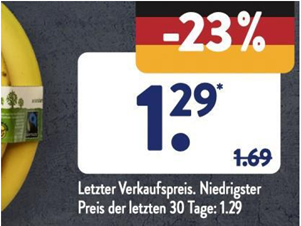
A German judge found it difficult to apply this provision and asked for guidance from the Court of Justice of the European Union (ECJ). The judgment was rendered on 25 September 2024. The facts are these. Aldi, a well-known supermarket company, distributes weekly a booklet with commercial information. The consumers’ association of the Land of Baden-Württemberg, Germany, took issue with how the price of bananas and pineapples were displayed, as they considered it violating Article 6a.

We will focus on the display of the price of bananas, for simplicity. Following a practice common in trademark cases but new – as far as I can tell – in consumer law matters, the ECJ includes a picture of the advertisement in its ruling:

The writing in white means: ‘Previous sale price. Lowest price in the last 30 days: 1.29’.

In essence, Aldi claims that the information in white is sufficient to comply with Article 6a, even if the discount is calculated as a percentage of the ‘chronologically prior’ price. The consumer association disagrees and points out that the 2021 Interpretive Guidelines on Article 6a by the European Commission support their view.

The referring judge has the doubts that the text of the directive requires the more demanding interpretation, despite what the guidelines say. The Court of Justice of the European Union sides with consumers. The answer is convincing and predictable, as it relies on a well-established practice in the interpretation of EU consumer law.

First, the ECJ points out that the interpretation of a provision of EU law requires one to look at its literal meaning, its objectives, and the system of norms it belongs to. Second, the Court finds that the plain meaning of the provision does to solve the interpretive doubt raised by the German judge.

Third, once teleological and systematic considerations come into play, the answer becomes clear. The directive aims to empower consumers by providing them with reliable and transparent information about prices (Recital 12). This objective is part of ensuring a high level of consumer protection, enshrined in Article 38 of the Charter of Fundamental Rights and 169 TFEU.

The interpretation proposed by the German judge would not be effective in protecting the interests of consumers. Therefore, the ECJ rejected it, confirming the consumers’ association view that Aldi’s conduct was not compliant. Thus, discounts must be calculated based on the ‘legal prior’ price as defined by Article 6a and not based on the ‘chronological prior’ price.

One point connected to Article 6a remains unclear to me. I wonder if Article 6a should not be interpreted as prohibiting displaying the ‘chronological prior’ price. After all, EU law deems it deceptive compared to the ‘legal prior’ price. I believe that, sooner rather than later, this question will be asked to the Court of Justice of the European Union.

This decision confirms that Article 6a has increased the level of transparency of a critical information such the final price. Price stability over time is a crucial element in this regard. Traders are free to adjust prices as often as they want, but should refrain from using this freedom to artificially increase the attractiveness of a price reduction.

The concept of a ‘reference price’ in consumer law is a novelty at first glance. Yet, this has an important predecessor in anti-usury laws. An often-used technique to fight usury is calculating a ceiling interest rate that can be legally charged. Rates about it are prohibited (with criminal sanctions).

The reference price of Article 6a is different in that it is based only on the prices offered by the specific trader. This concept represents a telling example of the two-fold challenge of consumer law and market law: a nuanced understanding of business practices must be coupled with ingenious regulatory solutions.

Regarding the relationship between EU ad national law, the decision illustrates an important point. A part of EU legal scholarship is very vocal about the vices of EU law, which is seen as systematically underperforming in comparison to national law. The present decision is an excellent example of the positive role of EU law: in comparison to the interpretation given by the ECJ, the German judge preferred a reduced level of consumer protection.

At the same time, the issue of the prior price is telling about another controversy regarding the EU-national relation. In fact, the Price Indication Directive is a minimum harmonization directive, which enabled Portugal to ‘experiment’ and find a solution earlier than the EU. Most probably, the Portuguese solution was actually transplanted by the EU in all Member States. Had the directive been a maximum harmonization one, or even a regulation, this dynamic from one Member State to the whole Union would not have been possible.

Considering that EU law has moved towards an increased use of maximum harmonization directives and regulations, there is indeed reason for concern about the loss of flexibility and regulatory innovation in the Union.

The matter of prices is particularly prominent in this regard. One of the main preoccupations in the digital economy is the use of personalized or surveillance prices in digital markets. As I argued elsewhere, the ‘legal prior’ price of Article 6a confirms that the law can (and arguably does) force traders to show personalized prices as variations of the impersonal price. In sum, to empower us, the consumers, the law can make prices through time. What else can we make it do? Imagination, not the sky, is the limit.